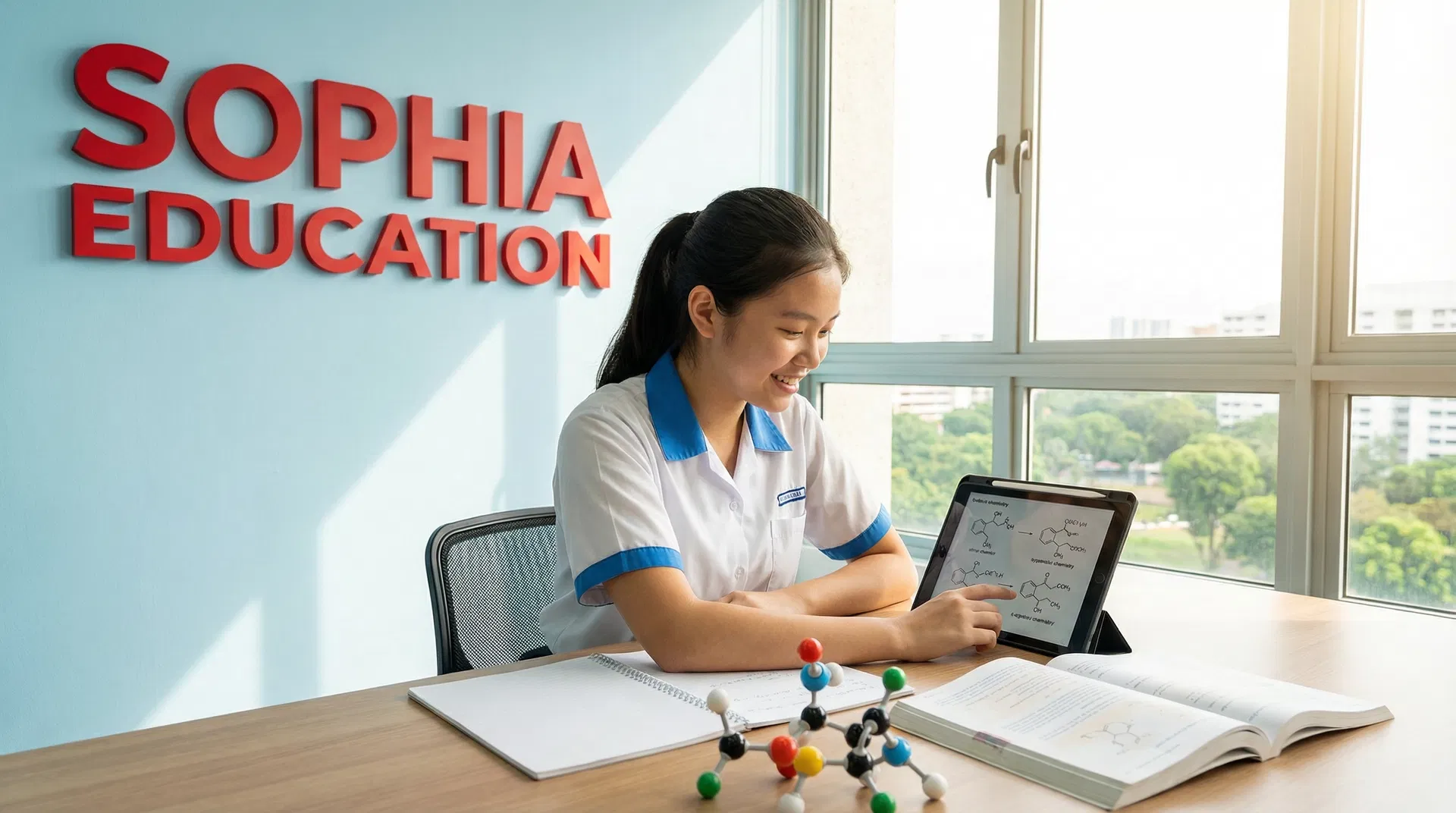
Complete Guide to JC H2 Chemistry Organic Chemistry: Tips from Top Tutors
Organic Chemistry makes up roughly 40% of H2 Chemistry marks. Our experienced JC Chemistry tutors share the complete framework for mastering every reaction type, mechanism, and functional group tested in A-Levels.
Organic Chemistry is the section that determines whether a JC student scores an A or a B in H2 Chemistry. It accounts for approximately 40% of the A-Level paper and requires both deep conceptual understanding and meticulous memorisation of reaction conditions. At Sophia Education, we have developed a systematic approach that helps our students master organic chemistry in just 8 weeks.
The 6 Functional Groups You Must Master
- ✓Alkanes and Alkenes — free radical substitution and electrophilic addition
- ✓Halogenoalkanes — nucleophilic substitution (SN1 vs SN2) and elimination
- ✓Alcohols — oxidation, esterification, and dehydration reactions
- ✓Carbonyl Compounds (Aldehydes and Ketones) — nucleophilic addition and oxidation tests
- ✓Carboxylic Acids and Derivatives — esterification, acyl chloride reactions
- ✓Amines and Amino Acids — basicity, reactions with acids, peptide bonds
How to Remember Reaction Conditions
The most common reason students lose marks in organic chemistry is forgetting reaction conditions. Our tutors recommend creating a "Conditions Card" for each functional group — a small index card listing every reaction that functional group undergoes, with the exact reagents, conditions, and products.
The Organic Synthesis Framework
Organic synthesis questions require you to convert one compound into another using multiple steps. The key is to work backwards from the target molecule. Identify the functional group of the target, then ask: "Which reaction produces this functional group?" Work backwards until you reach the starting material.
Pro Tip: In synthesis questions, always check that your reagents are compatible with all functional groups present in the molecule, not just the one you are targeting.
Distinguishing Tests You Must Know
- ✓Tollens reagent (silver mirror) — distinguishes aldehydes from ketones
- ✓Fehling's solution (brick-red precipitate) — detects aldehydes
- ✓Bromine water (decolourisation) — detects C=C double bonds or phenol
- ✓Acidified KMnO4 (purple to colourless) — detects alkenes
- ✓2,4-DNPH (orange precipitate) — detects carbonyl compounds
- ✓Iodoform test (yellow precipitate) — detects CH3CO- group
Sophia Education's JC Chemistry classes are taught by tutors with first-class honours in Chemistry from NUS and NTU. Our students consistently achieve 85%+ A/B rates at A-Levels. Book your trial lesson today.
Trial Lesson
Struggling with JC Chemistry? Our expert tutors can help. Book a trial lesson today — no commitment required.
WhatsApp Us Now →📞 +65 8875 0044About the Author
Mr Joson Ng is a specialist tutor at Sophia Education Singapore, with extensive experience teaching JC Chemistry to students across JC, O-Level, IP, and PSLE levels.

Want to Improve Your JC Chemistry Grades?
Join hundreds of Singapore students who improved their grades with Sophia Education's small-group tuition.